
English| EUR
Suggested for you
More currencies
Choose a language
Nusa Lembongan sits inside the Nusa Penida Marine Protected Area, where nutrient-rich currents from the Indonesian Throughflow create one of Southeast Asia's most biodiverse diving environments. The island's six main dive sites range from gentle coral gardens to adrenaline-charged drift dives through underwater channels. Manta rays, mola mola, and reef sharks pass through seasonally, while the protected waters maintain year-round visibility between 15 and 30 meters.
Quick answer
The best scuba diving Nusa Lembongan experiences center on Manta Point for seasonal manta ray encounters (April through November), Crystal Bay for mola mola sightings during the cooler months (July to October), and the drift channels at Ceningan Wall and Blue Corner. Most dive operators run two-tank morning trips departing between 07:00 and 09:00 to catch optimal visibility before afternoon currents strengthen. All divers pay a mandatory 100,000 IDR marine protected area retribution fee.
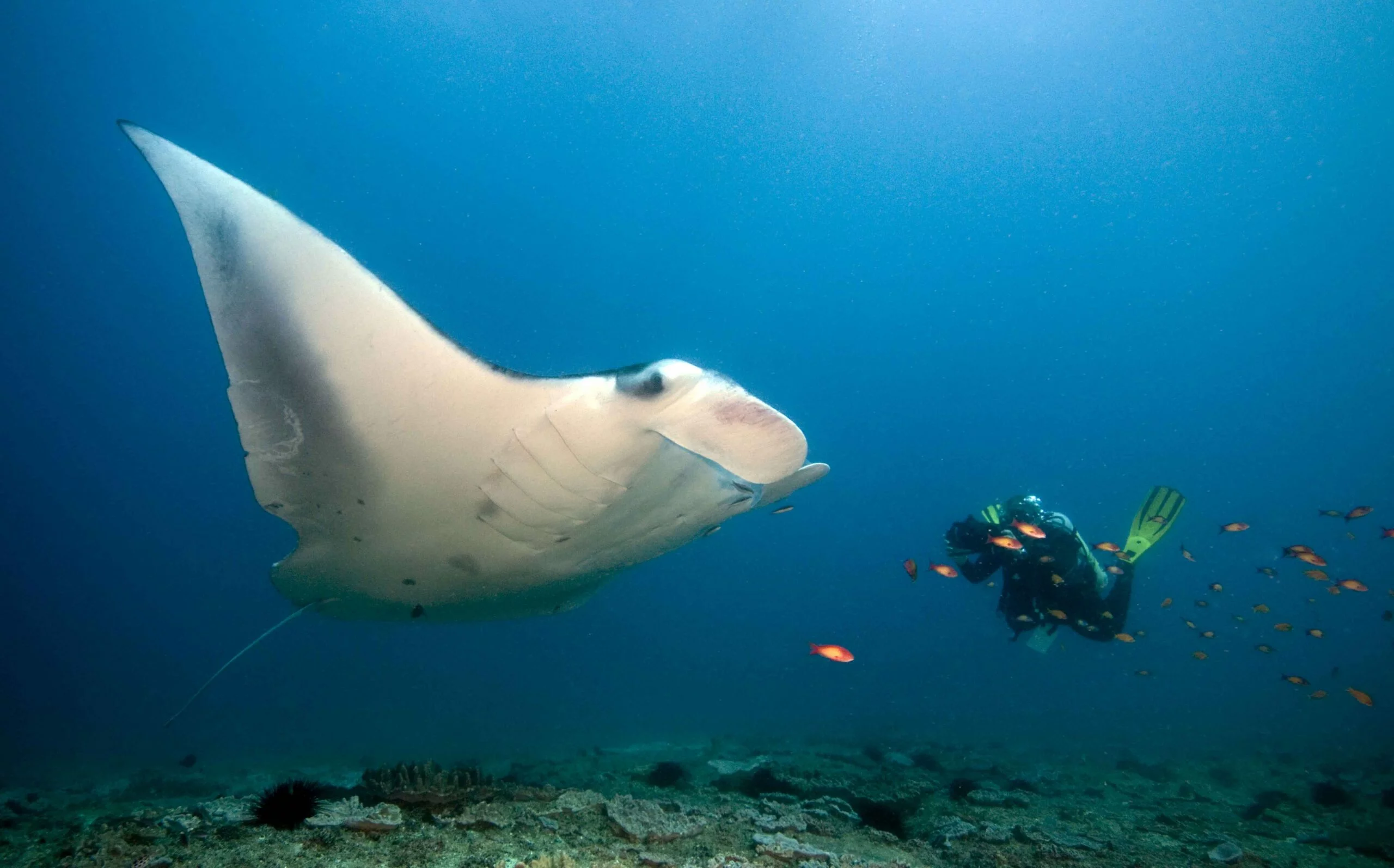
Nusa Lembongan's underwater topography is shaped by the Lombok Strait, where deep ocean currents surge between Bali and Lombok twice daily, funneling pelagic species and nutrients into shallow reef systems. The result is drift diving that moves experienced divers through vertical walls and coral-encrusted channels at speeds that can exceed two knots. Manta Point anchors the island's reputation. The cleaning station here draws oceanic and reef mantas year-round, with peak aggregations between April and November when plankton blooms thicken in the water column. Divers descend to a sandy plateau at 10 to 18 meters and hold position while mantas circle overhead, sometimes in groups of eight or more. The site requires moderate current management and neutral buoyancy—stirred sand reduces visibility and disrupts the cleaning behavior. Crystal Bay offers a contrasting profile: a sheltered cove with a sloping reef that bottoms out near 30 meters. Between July and October, mola mola ascend from deep water to visit cleaning stations along the bay's southern wall, typically in early morning dives. Water temperature drops noticeably at depth during mola season, and thermoclines can reduce visibility to under 10 meters. The bay's protection from prevailing currents makes it accessible to intermediate divers when outer sites are too rough. Ceningan Wall and Blue Corner deliver the channel dives Lembongan is known for. These sites run along the strait between Nusa Lembongan and Nusa Ceningan, where tidal flow accelerates through a narrow gap. Divers drift past gorgonian fans, black coral trees, and walls covered in soft corals while white-tip reef sharks and schooling trevally move through the blue. Current timing is critical—slack water windows last 20 to 30 minutes, and mistimed entries result in aborted dives. The marine protected area status, established in 2010, restricts fishing and anchoring across 20,279 hectares. Coral cover has increased measurably in the past decade, and reef fish biomass is visibly higher than unprotected sites on Bali's mainland coast. Dive operators work with village cooperatives to collect the retribution fee and fund patrol and mooring maintenance.
“Nusa Lembongan's drift channels move experienced divers through vertical walls at speeds exceeding two knots, funneling pelagic species into shallow reef systems.”
The best arrival window for diving in Nusa Lembongan is 07:00–09:00. Early morning departures are essential to avoid stronger afternoon currents and ensure optimal visibility.
Dry, 26°C to 29°C
Stable conditions provide the most consistent visibility for diving. These months offer lower rainfall and favorable sea states.
Humid, 27°C to 30°C
Expect occasional rain showers. While surface conditions vary, underwater visibility can remain good between storms.
—
Arriving at 07:00 avoids weekend surges. Diving during this time minimizes interaction with stronger tidal currents prevalent later in the day.
Verdict: The best time to experience scuba diving in Nusa Lembongan is during the dry season months of April to October, arriving daily within the 07:00–09:00 window.
The diving centers in Nusa Lembongan operate on a consistent daily schedule throughout the week.
The dive center is located in Jungut Batu, the primary village on Nusa Lembongan. Access is via fast boat services departing from Sanur Beach in Bali.
Fast boat from Sanur Beach to Jungut Batu Harbor
Walk from Jungut Batu Harbor to the dive center
Plan your travel to reach the island during the early morning arrival window to ensure you are ready for scheduled departures.
Navigating the waters around Nusa Lembongan requires specific preparation due to the region's dynamic underwater conditions.
Currents in the Nusa Penida Marine Protected Area can shift rapidly and unpredictably. Always perform a negative entry if your dive master advises, ensuring you descend quickly to the reef line before currents push you off the site.
Maintain a neutral position within a few meters of the reef structure to minimize exposure to strong mid-water currents. This technique conserves energy and allows you to hide from flow behind large coral formations.
Carry a reef hook for sites like Manta Point or Crystal Bay to stabilize yourself during high-flow conditions. Only attach the hook to dead coral or rock substrate to protect the living ecosystem.
Perfecting your buoyancy is critical because the complex topography often features sharp drop-offs and changing water densities. Being able to hover effortlessly prevents accidental contact with the sensitive coral environment.
Even in tropical temperatures, thermoclines occur frequently when deep, cold water upwells from the Indian Ocean. Wearing a 3mm or 5mm wetsuit ensures you remain comfortable during long safety stops in these cooler patches.
Everything you need to know about best scuba diving nusa lembongan
Finding the best scuba diving nusa lembongan involves exploring diverse sites like Manta Point or Crystal Bay. These locations offer vibrant coral reefs and encounters with marine megafauna such as manta rays. Visitors often engage in PADI certification courses or recreational fun dives to explore the Nusa Penida Marine Protected Area.
To achieve the best scuba diving nusa lembongan results, plan your arrival between 07:00–09:00. Early morning departures are essential to avoid stronger afternoon currents and ensure optimal visibility for your underwater excursions. This schedule maximizes your chances of seeing pelagic species while minimizing exposure to unpredictable sea conditions.
Every visitor entering the Nusa Penida Marine Protected Area is required to pay a mandatory retribution fee of 100,000 IDR. This fee supports local conservation efforts and the preservation of the reef ecosystem. Ensure you have this amount ready upon arrival to facilitate your entry into the park.
The dive center is conveniently located in Jungut Batu, Nusa Lembongan, Bali, Indonesia. This central location serves as the primary base for organizing daily boat trips and equipment rentals. You can find their office situated near the main coastal access points for easy embarkation.
Yes, many operators provide programs suitable for those seeking the best scuba diving nusa lembongan, including introductory discover scuba sessions. Professional instructors guide participants through basic skills in confined water before progressing to open ocean sites. Safety standards remain high across all reputable local dive shops.
To reach the dive sites, visitors typically board boats directly from the beach in Jungut Batu. Organizing transport to the island beforehand is recommended to ensure you arrive within the preferred early morning window. Once on the island, the dive center coordinates all sea-based logistics.
The dive center is open daily from 07:00–19:00 to handle bookings and inquiries. You may visit during these hours to speak with staff or prepare your gear for the following day. Outside of these hours, you can reach the team via phone at +6281339752232.
The best scuba diving nusa lembongan conditions are defined by clear water and manageable drift currents, which are most frequent during the morning. Avoiding the afternoon peak ensures you experience the best visibility while diving among the local landmarks. Proper preparation and early scheduling are the keys to a successful day at sea.