Nusa Lembongan Scuba Diving: Manta Rays & Mola Mola
Explore vibrant underwater worlds around Nusa Lembongan and Penida, encountering majestic manta rays and sunfish
Reserve
Hand-picked by our editors — only the best 5 dive experiences from 18 reviewed.
Verified partners for every tour, free cancellation where available, and instant confirmation on every booking.
Explore vibrant underwater worlds around Nusa Lembongan and Penida, encountering majestic manta rays and sunfish
Reserve
6 hr
Encounter graceful manta rays, explore three pristine snorkel sites, and kayak through mangrove waterways
Reserve
3 hr
Swim with giant manta rays and explore three stunning snorkel sites around Nusa Penida's crystal-clear waters
ReservePrices from verified partners. Availability updates in real time at checkout. Free cancellation policies apply where shown.
The landmarks, rooms, and views travelers on this tour remember — all visible on a single visit.
The primary gathering point where large reef manta rays visit for parasite removal by small cleaner fish. This area features a shallow reef structure that is ideal for observing the natural behavior of these giants from a safe distance.
A dramatic, horseshoe-shaped rocky outcrop that shelters the dive site from extreme swells. The reef floor typically sits between 10 and 20 meters, providing a perfect backdrop for the manta dance.
A deep-water passage known for attracting large marine life including occasional reef sharks and migrating oceanic species. Current flows here are consistent, making it a hotspot for nutrient-rich water that feeds the local manta population.
A clearer, shallower shelf at the edge of the site offering high visibility for snorkeling sessions. This is where most groups gather to watch mantas soaring near the surface.
They serve different purposes, but most visitors who participate in a manta ray scuba diving nusa lembongan tour find the immersion significantly more rewarding than surface viewing. You can secure manta ray scuba diving nusa lembongan tickets or opt for manta ray scuba diving nusa lembongan tours depending on your comfort with deep-water marine exploration.
| Feature | Top pick Scuba Diving | Snorkeling |
|---|---|---|
Experience Depth |
Submerged at depth | Surface observation only |
Interaction Proximity |
Close proximity with neutral buoyancy | Limited to surface distance |
Equipment Requirements |
Full scuba kit and certification | Mask, snorkel, and fins |
Skill Level |
Advanced PADI or equivalent | Basic swimming ability |
Marine Life Visibility |
Wide range of pelagic species | Subject to surface clarity |
Price |
1,500,000 IDR (approximate) | 600,000 IDR (approximate) |
| See tickets → |
Verdict: Scuba diving offers a superior connection to the aquatic environment, while snorkeling provides an accessible, low-barrier way to view these majestic creatures in their natural habitat.
Choose your ticket, select your date, and reserve in under two minutes. Secure checkout handled by our verified partner.
Instant confirmation by email, with a mobile voucher you can save offline. No printing, no queuing at a collection desk.
Arrive at the entrance, show your voucher on your phone, and walk in. Most tickets include priority or skip-the-line access.
Practical details for your visit straight from our verified partners — hours, access, rules, and how to get there.
Wear swimwear and bring a rash guard or 3mm wetsuit for comfort in cool open-ocean currents. Ensure you have dry clothing and a towel for the return boat trip.
Use waterproof dry bags for electronics and personal belongings. Keep gear minimal as boat space is limited and shared with other divers.
Ensure your camera has a secure wrist strap or float. Disable flash settings to avoid startling the manta rays, as per official interaction guidelines.
Trips are best suited for confident swimmers due to open-water conditions. Life jackets are mandatory and provided by all licensed boat operators.
Minimum age for manta ray scuba diving nusa lembongan tours is typically 10 years old. Consult with individual operators regarding specific child suitability and safety requirements.
Bring reusable water bottles for hydration throughout the boat trip. Most full-day manta ray scuba diving nusa lembongan tours provide lunch as part of the package.
Best time to go, insider tips, nearby landmarks, and the cancellation fine print — flip through to skim what matters to you.
Flexible, no hidden fees.
Operators typically offer free cancellation at least 1 day before the scheduled start time. No refunds are provided for cancellations made less than 1 day before the activity.
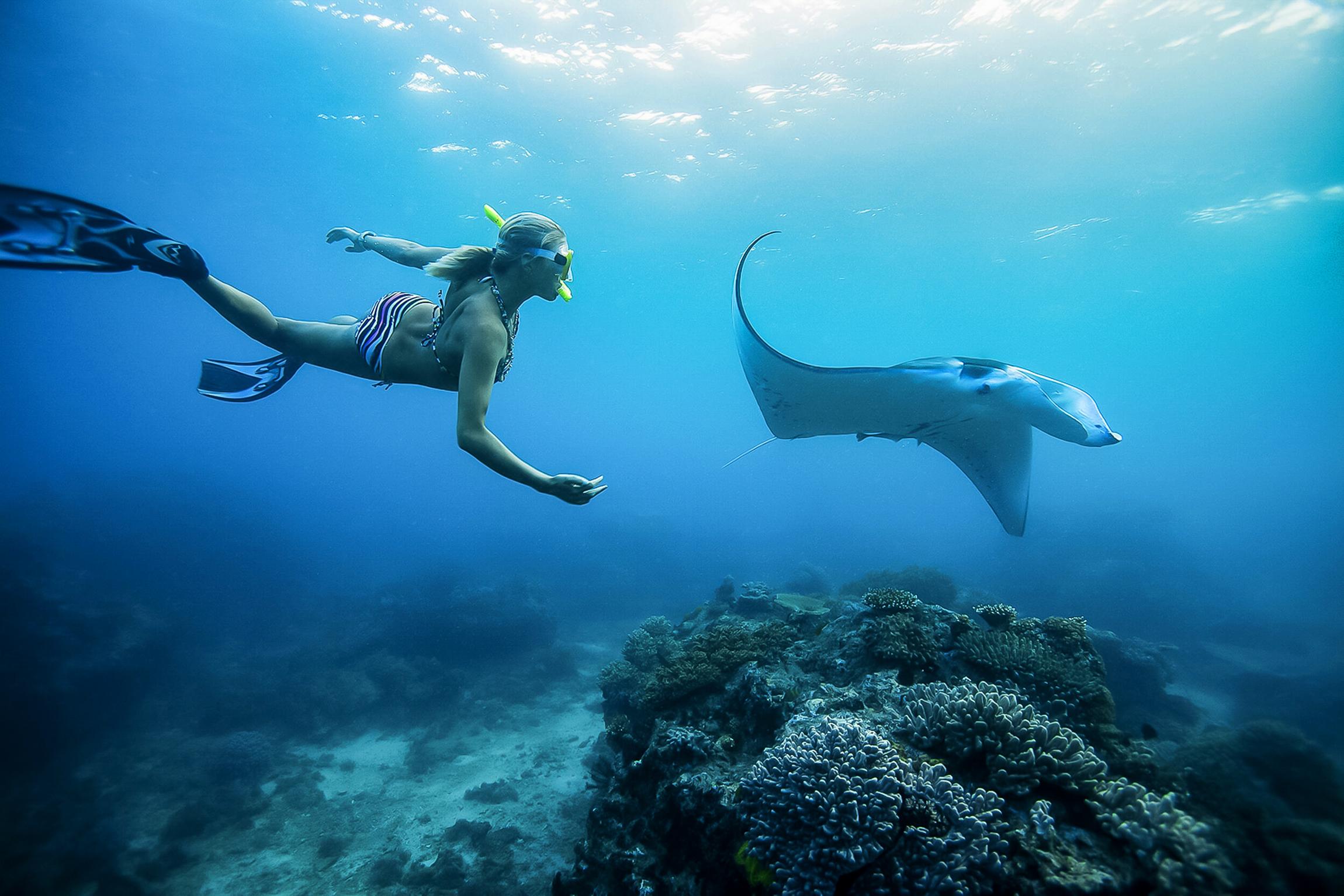
Manta Point sits in the channel between Nusa Penida and Nusa Lembongan, where nutrient-rich upwellings from the Lombok Strait meet shallow reef plateaus at eighteen to thirty metres. The site was formally surveyed in 1999, though local fishermen had reported seasonal congregations of oceanic mantas for decades prior. By 2008, dive operators from Lembongan had established permanent moorings, and in 2010 the Klungkung Regency designated the zone a Marine Protected Area, banning extractive fishing within a two-kilometre radius. The protection paid off. Resident manta populations now number between sixty and eighty individuals, identified by unique ventral spot patterns logged in the Manta Matcher database maintained by the Marine Megafauna Foundation. Manta ray scuba diving nusa lembongan operates year-round, though encounter probability peaks between April and November when plankton blooms draw larger aggregations. The mantas circle three cleaning stations on the plateau, where wrasse and cleaner shrimp service their gills and ventral surfaces. Divers descend via mooring lines, settle on the sand at twenty-two metres, and watch the circuit. A single manta's wingspan averages four metres; mature females reach five. The animals are curious, often banking within arm's reach to inspect bubbles or camera housings. Between August and October, seasonal thermoclines also bring mola mola — ocean sunfish — to the cleaning stations, adding a second megafauna species to the same dive. The site's accessibility from Lembongan keeps boat transit under twenty-five minutes, allowing operators to schedule two-tank dives with a surface interval at Ceningan Wall or Crystal Bay. Current can hit two knots on the spring tide, strong enough to require reef hooks and negative entries. Visibility ranges from twelve to thirty metres depending on tidal phase. The Marine Protected Area permit, introduced in 2018, funds ranger patrols and mooring maintenance; compliance is enforced at the harbour before departure. Nusa lembongan manta diving has become a benchmark site in Indo-Pacific manta research. Photographic ID submissions from recreational divers contribute to population tracking, migration studies, and behavioural analysis. The data revealed that several individuals tagged at Manta Point have been resighted at Komodo and Raja Ampat, confirming long-range coastal movement. The site's dual role as both dive destination and citizen-science platform underscores the economic value of live manta populations over extractive use.
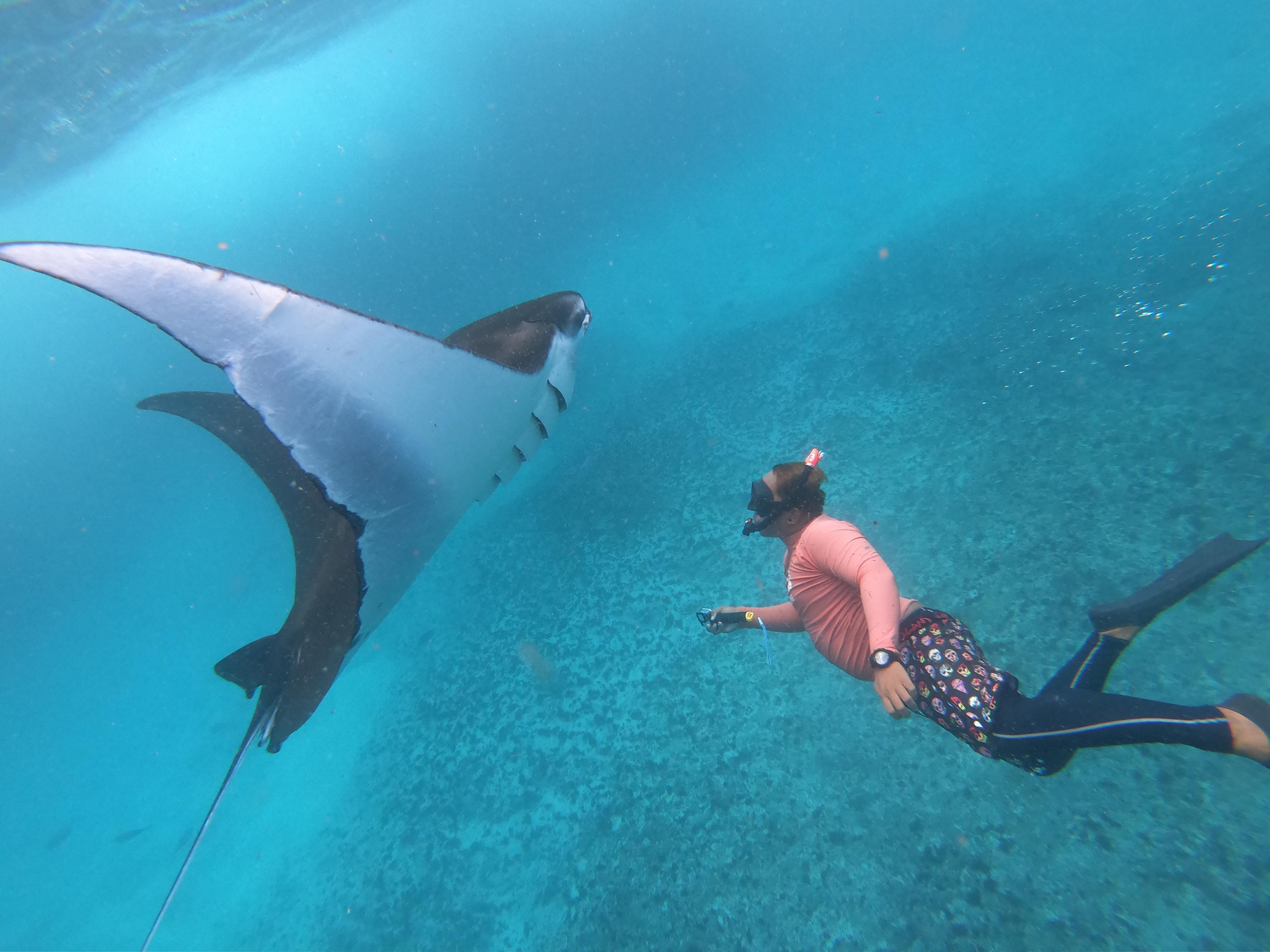
"A single manta's wingspan averages four metres; mature females reach five."
A step-by-step walkthrough of the visit — what you'll see, how long each stage takes, and the details that matter.
You board the dive boat at Jungut Batu harbour before first light, crossing the strait as the sun clears Gunung Agung. The crew briefs the dive plan on the twenty-minute crossing: negative entry, descend the mooring line to twenty-two metres, hold position on the sand near the cleaning station. You gear up, perform buddy checks, and roll backward into the blue. The mooring line drops through the thermocline at fifteen metres, temperature falling from twenty-eight to twenty-three degrees. You fin down to the plateau, find your spot, and clip your reef hook to a dead coral head. The current pulls your BCD horizontal. The first manta appears as a shadow against the surface glare, banking into a slow spiral above the cleaning station. It completes one orbit, then another, wrasse darting along its gill slits. A second manta joins, then a third. You stay low, exhaling slowly to minimise bubble streams. One manta breaks its circuit and glides toward you, wing tips flexing, cephalic fins unfurled. It passes overhead close enough to count the individual gill rakers, then resumes its loop. Your dive computer reads eighteen minutes of bottom time remaining. The mantas continue their circuit, unbothered, as cleaner fish service the queue.
The attraction area is accessible from 06:00–19:00 daily. Most operators schedule departures during these hours to ensure safe sea conditions.
Yes, all visitors must pay an entrance fee of 100,000 IDR (Marine Protected Area (MPA) permit, per person per day) to support conservation efforts.
Arrive between 06:00–09:30 to avoid the influx of large day-tripper crowds arriving after 09:30.
Yes, but participants should be confident swimmers; operators usually require a minimum age of 10 for manta ray scuba diving nusa lembongan excursions.
Prohibited items include single-use plastics and harmful sunscreens to protect the marine ecosystem of the Manta Point address.
Maintain a 3-meter distance and disable flash; manta ray scuba diving nusa lembongan tours prioritize ethical interaction with marine life.
Yes, manta rays are present year-round, though sea conditions may vary. Always check with your operator for daily updates.
Cancellations at least 1 day before the start are generally free. Please check your specific manta ray scuba diving nusa lembongan tickets policy.
Nearby spots include Crystal Bay and Gamat Bay, often combined into manta ray scuba diving nusa lembongan tours.